
Tracking Cattaraugus County Recent Arrests
No single list captures every arrest in Cattaraugus County. Sheriff deputies, Olean and Salamanca police, state officers, and other agencies all make arrests here. What happens next varies widely. A person might get an appearance ticket, be released on recognizance, face arraignment, or post bail. Others are remanded to Cattaraugus County Jail. Remand simply means a judge ordered the person held. Someone processed and released may show up in a Sheriff report. That person never joins the jail roster. The reverse happens too. A person held after court sits in custody with no press release at all.
The Sheriff Inmate Search covers active county custody. The Sheriff news stream adds detail on selected events. The releases often lag the roster by days. Neither source promises a rolling 24-hour list or a fixed posting time.
| Official view | Coverage | Photos | Limit |
|---|---|---|---|
| Active roster | Current county custody | All observed cards had images | Not every arrest leads to jail |
| Newest releases | Selected events and outcomes | Reviewed arrest posts were text | Not a guaranteed daily feed |
| Press digest | Finite multi-day stream | No systematic photo set | Includes non-arrest news |
Cattaraugus Arrest Feed Windows
The county posts no dedicated URL labeled a 24-hour arrest list. For same-day questions, the roster is the strongest check, and the newest Sheriff reports supply event detail whenever they appear. The 24 Hour Arrests page explains that fallback. The wider press stream, Salamanca's monthly reports, and dated reporting feed the multi-day Arrest Log instead.
The Sheriff digest holds about 100 mixed entries at a time, reaching back roughly two months at its oldest item. That depth is not a retention promise. Publication runs on events, not a schedule. A roster card proves custody at that moment; a release proves a reported event. Neither settles what the court later decides. The official Sheriff release stream is the publication channel.
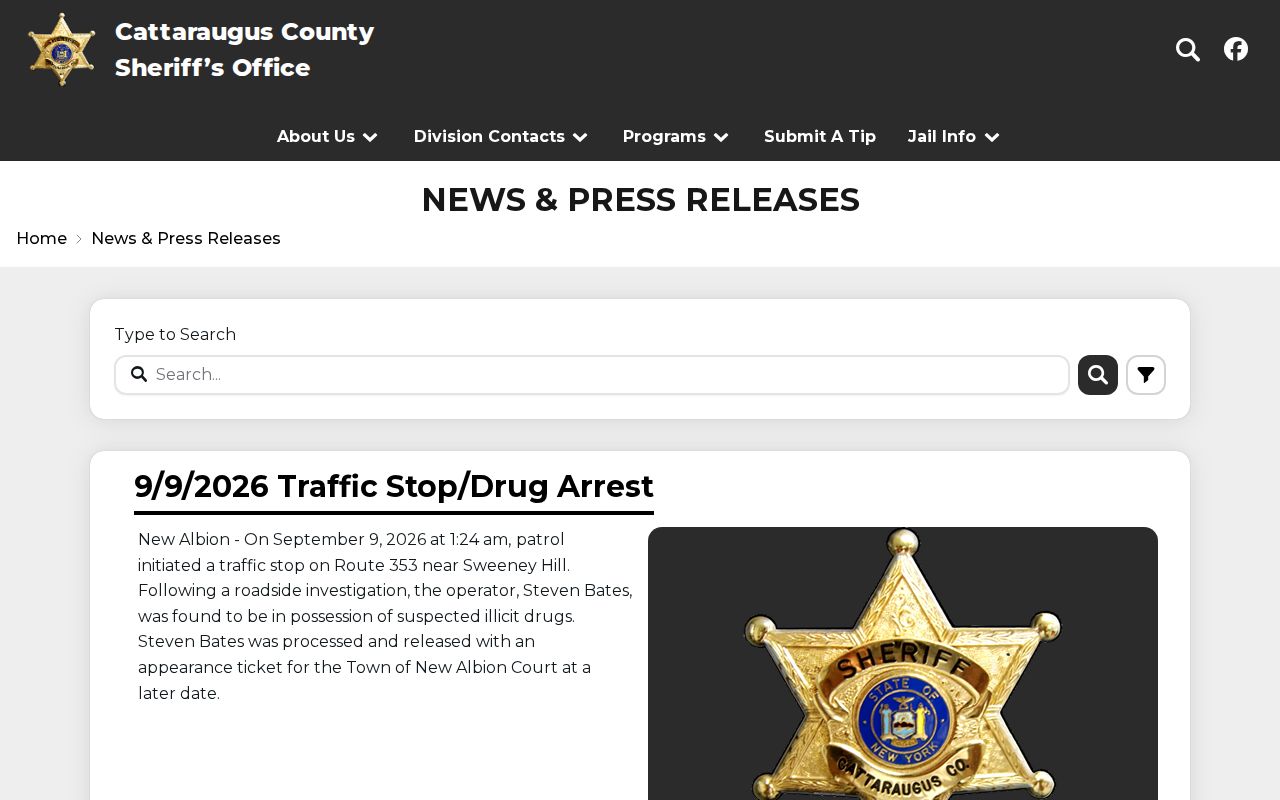
The capture is not a promise that every arrest appears there.
Cattaraugus County Arrest Roster
Cattaraugus County Jail holds sentenced and unsentenced adults. It also holds youth ages 16 through 18 in a 148-bed maximum-security facility. County materials note it also houses federal inmates. Capacity, though, says nothing about arrest volume. Appearance tickets, bail, releases, and holds from other authorities all decide whether a name appears. Treat the roster as a snapshot of active custody, never a full arrest log.
The jail's OCV service ties into Appriss VINE. No rule governs how fast entries refresh. Nothing sets when released people drop off or how far back the list reaches.
| Field | Use | Caution |
|---|---|---|
| Name and inmate ID | Match identity | ID is not a case number |
| Booked date | Place intake in time | May differ from incident time |
| Custody state | Read current status | It can change |
| Charge and bond data | Read booked charges and terms | Not final disposition |
| Descriptors and image | Separate similar names | Not proof of guilt |
Open the official search and filter by name. Compare the ID, booking date, status, and charge details against what you know. Note when you checked. Then verify through VINE and the court before drawing conclusions. A missing match does not rule out an arrest. A ticket, a release, a transfer, a lag, or a sealed record can all explain the gap. The official Cattaraugus County Inmate Search is the place to begin.
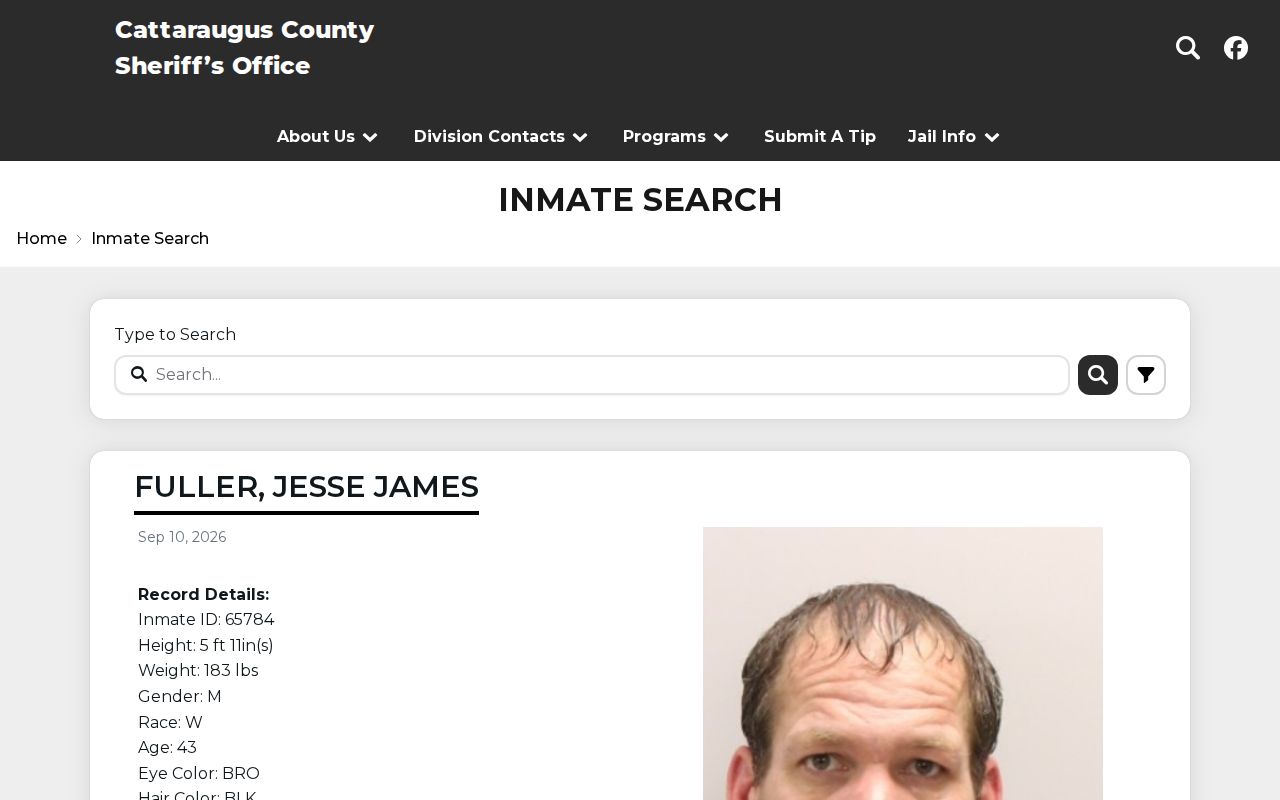
It leads to individual custody records, not a locally hosted gallery.
VINE Behind Cattaraugus Arrest Records
VINE sits inside the roster system itself, not beside it. The data runs through NYSWVINE and the Sheriff agency ID. Images come from Appriss VINE. The Sheriff app bundles inmate information, VINE alerts, press releases, Most Wanted, and tips. All of it sits in one place. Think of it as a second official doorway, not a separate database. The VINELink Check explains release and transfer alerts for a single person. For urgent custody questions, call the jail directly. VINE is neither a court record nor a photo archive.
Where Cattaraugus Arrests Appear
Official sources come first because they define custody and maintain the record. News adds context. Private publishers merely aid discovery, and they may copy entries, lag behind, or leave a card up after the official status changes.
| Channel | Photo | Authority |
|---|---|---|
| Sheriff roster | Observed | Official current custody |
| Sheriff releases | Usually no | Official event reports |
| Salamanca reports | No photo roster | Official municipal |
| Local news | Varies | Secondary reporting |
| Busted Newspaper | Yes | Unofficial; verify |
| RecentlyBooked | Yes | Unofficial; observed dates varied |
| Mugshots.com | Yes | Unofficial; chiefly older entries observed |
Arrests.org and Mugshots.zone list no Cattaraugus-local page. Local coverage comes from Olean Times Herald, WESB, J²Press, The Post-Journal, Chautauqua Today, and WNY News Now. None follow a set cadence. Agency and court records control any corrections.
Cattaraugus County Arrests by City
Olean runs its own police department and a Records Room but posts no public daily roster. Salamanca publishes monthly police reports plus a dated warrant link. Little Valley offers no municipal blotter, so Sheriff sources are the practical route there.
- Olean Recent Arrests: separate city reports from county-jail custody.
- Salamanca Recent Arrests: use monthly reports, then check county custody.
- Little Valley Recent Arrests: start with Sheriff records, roster, and VINE.
A city arrest can end with no jail card at all, while a county card may follow a city arraignment and remand.
Cattaraugus County Arrest Record Fields
Booking is the intake step that follows an arrest. A roster record carries many fields. It can include an inmate ID, name, booked date, custody status, charge code, and description. Bond type and amount, age, height, weight, gender, race, hair, eyes, and an image may appear too. It is not the complaint. It is not a full case file, a criminal history, or a final outcome. Medical, victim, informant, juvenile, sealed, investigative, and safety material can all be restricted.
- Arraignment
- The first court appearance.
- Bond
- Terms tied to release while a case proceeds.
- Disposition
- The court’s recorded outcome.
- Detainer
- A hold requested by another authority.
- Sealing
- A legal restriction on access to qualifying records.
Cattaraugus Arrest Photos and Mugshots
On the Cattaraugus County jail roster, each booking entry pairs the arrest details with a booking photo. Police press releases work differently. They announce arrests in plain text. Keep in mind that photos can drop off once the roster turns over, so a missing image proves nothing about the arrest itself. The state system is separate. DOCCS takes identification photos of people in its custody, yet its public locator lists no photo gallery. To see a specific state record, ask DOCCS directly, and for anything local, check with the arresting agency or the court.
Request a Cattaraugus Arrest Record
New York's FOIL opens most agency records to the public, exemptions aside. A good request starts with specifics. Call the Sheriff Records Clerk at extension 2399 with the full name, a narrow date range, the inmate ID if known, the agency, and exactly which records you want. Ask for electronic copies, advance notice of costs, and the legal basis for anything withheld. Paper copies run $0.25 per page. State guidance gives the office five business days to grant, deny, or acknowledge a request, not to finish it.
Custody records live in more than one office. The Sheriff holds the county booking or commitment record, the booking photograph, charge and bond entries, and any release or transfer notation. The arresting police agency keeps its own incident or arrest report. The court clerk keeps the docket and the certificate of disposition. Ask each office for what it owns. So one office alone cannot tell the whole story, since the jail roster will never contain the full police file and a police report cannot settle what the court finally decided.
The county FOIL form goes to the Cattaraugus County Clerk, Records Access Officer, at 303 Court Street in Little Valley. It lets a requester ask for inspection or copies, and it lists fax number 716-938-2773. The County Administrator serves as Records Appeals Officer. State guidance allows an appeal within 30 days and requires the appeal officer to respond within 10 business days. The local wording is brief. Trust the agency's actual response over the form's shorthand.
Electronic copies cut paper charges but do not always come free. New York rules let agencies charge actual costs for some electronic production. The Sheriff's office lists no separate booking-photo fee. Ask for a cost estimate before work begins. When part of a record is exempt, request every reasonably separable portion rather than accepting a blanket denial. Skip confidential material entirely. Medical, victim, juvenile, informant, and safety-sensitive records should stay out of any publication request.
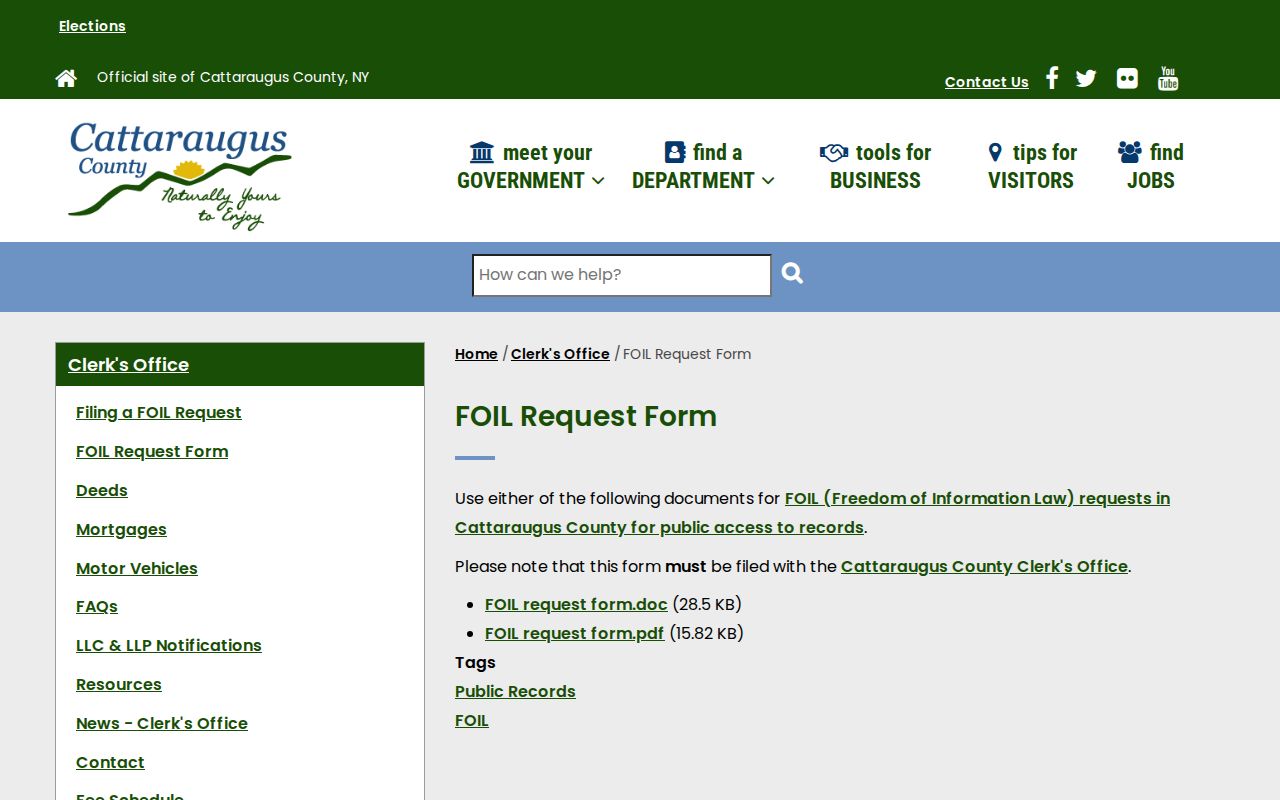
Release still depends on custody, exemptions, and sealing law.
New York Arrest and Mugshot Law
New York's Public Officers Law Article 6 starts from a presumption of open records. Sections 87 and 89 carry the working rules: agency access, procedures, fees, and appeals. Redaction is allowed for privacy, safety, active investigations, confidential sources, and techniques, among other grounds. A Cattaraugus County arrest file can hold public and exempt material side by side. FOIL does not promise every booking photo or every page. When withholding, the records officer must cite a ground and release whatever portions are not exempt.
No statewide New York law bans the publication of booking photographs. There is no general pay-to-remove statute either. Assembly bill A675B from the 2025 session was a proposal, and a bill text is not a law. The real landscape is FOIL, case-specific exemptions, sealing rules, court confidentiality, and whatever policies a publisher sets for itself. One more limit applies. Lawful access never licenses stripping an image of its date, source, charge label, or current status.
CPL §160.50 seals official records after qualifying favorable outcomes. New York Courts counts acquittal, dismissal, an adjournment in contemplation of dismissal ending in dismissal, a decision not to prosecute, and some orders vacating a result. The statute can require fingerprints and photographs to be destroyed or returned, subject to its terms. CPL §160.55 covers certain noncriminal offenses and violations. CPL §160.57 seals specified convictions automatically. CPL §160.59 is different: a person must apply to the court after the waiting period, and eligibility is narrow. Rely on the actual order or certificate. Age alone does not seal a case. Youthful-offender records under CPL §720.35 and protected Family Court material call for extra care, and a private page displaying a record does not mean official disclosure stays lawful.
A roster card that disappears says little. It does not mean the file was destroyed, the charge was dismissed, or the person was acquitted. Release, transfer, a system refresh, or a display rule could explain it. The reverse also matters: a private copy can outlive the agency page, survive a favorable ending, or persist after sealing. For a correction, current court paperwork is the sound basis.
Correcting Cattaraugus Arrest Photos
Corrections begin with legal status. Was the case pending, dismissed, acquitted, sealed, or resolved through an ACD? Get the paperwork that proves it. That could be a certificate of disposition, a sealing order, or a dismissal. A conviction calls for correction proof. Then bring the request to the Sheriff Records Clerk. You can also use the original police agency. Include your full name, inmate ID, booking date, the exact source URL, and the court document. Fixing a public card, sealing a record, and destroying an agency record sound alike. They are three different requests.
The county roster publishes no takedown form and no fixed web-retention policy. A request built on embarrassment alone goes nowhere. Wrong identity, factual error, favorable disposition, or a sealing order carries real weight. Ask the agency two things. Does the public image remain authorized? Does the displayed data match the source record? Keep copies of what you send and what comes back.
Private publishers run free removal processes with their own grounds. Busted Newspaper wants the listing URL. It also asks for your contact details, a reason, and proof such as dismissal, acquittal, or sealing. RecentlyBooked accepts grounds like dismissed, sealed, juvenile, duplicate, wrong-person, incorrect, and outdated records. Mugshots.com points to maintenance or unpublishing paths. These are backed by signed official proof, identity theft, favorable outcomes, or court-ordered destruction. Treat these as changeable publisher policies, not guaranteed rights or official findings.
Stick to the free route. Avoid anyone claiming payment is required to remove an arrest photo. Send only the personal data the process truly needs. Sometimes the source page vanishes. A stale search result can linger anyway. Google's official outdated-content guidance explains how to clear the cached result. De-indexing does not erase the source or change a court record. Nor does it remove copies held by other services.
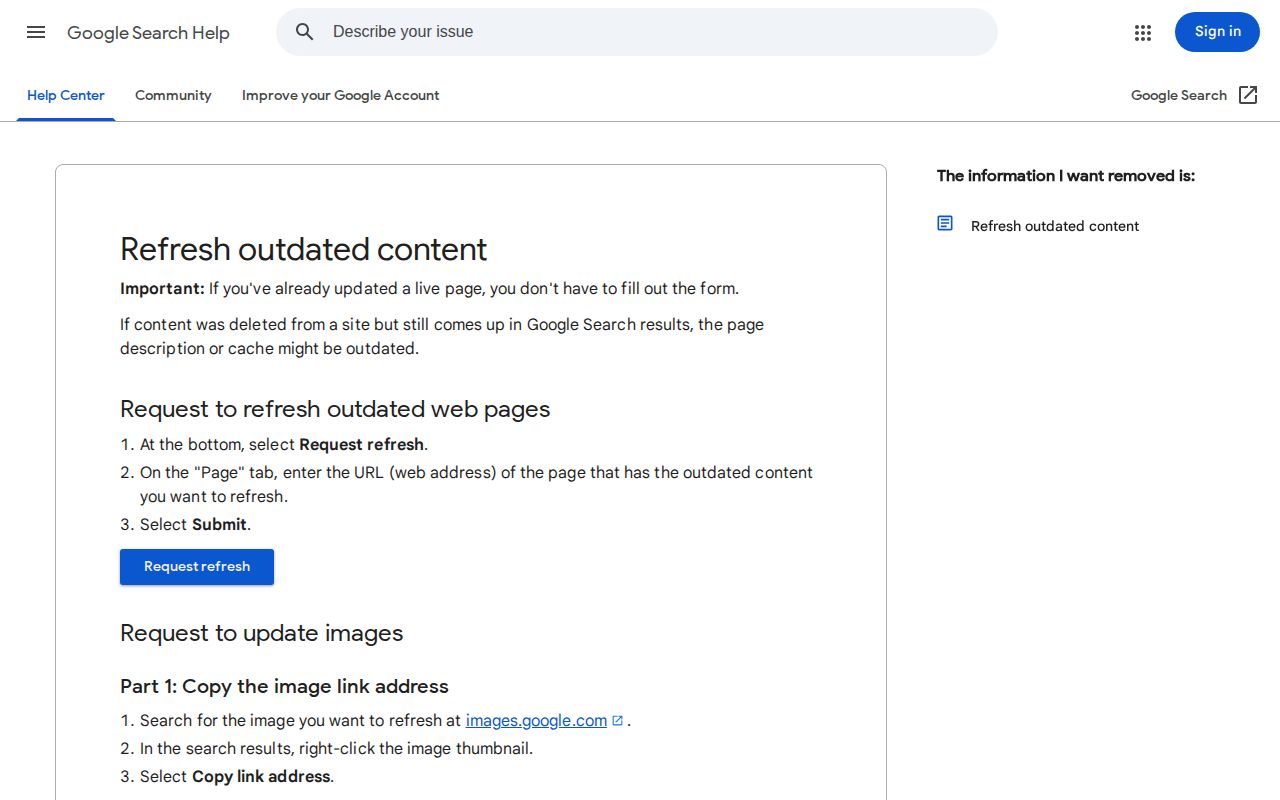
This is search cleanup, not a court order or publisher deletion.
Cattaraugus County Arrest Warrants
The county Most Wanted page displays a heading and a tip instruction, but no entries. An empty list is easy to misread. It does not mean Cattaraugus County has no warrants. The page publishes no update calendar, reward schedule, list count, or public archive. An older Top Ten article is still online. It is historical, and its names belong to no current wanted list.
For warrant questions, the Sheriff contact page lists extension 2217. The issuing court is the other verification route. These two checks answer different questions. The Sheriff can confirm or route a law-enforcement warrant matter when disclosure is allowed. A court clerk handles the court-side case or warrant record. A tip form sends information to police. It is not a private name-search service, so never use it to post confidential details publicly.
Salamanca Police links a dated municipal warrant image. Keep its date and issuing jurisdiction attached, since it is neither a countywide nor a statewide list. A warrant shown on that image may already have been executed, recalled, or changed. Olean's official police page carries no similar list. Town and village matters belong with the issuing court or the responsible agency, not inferred from Salamanca material.
Verify and resolve a warrant lawfully. A lawyer, a court, or the proper agency are the right channels. Never approach or confront a wanted person. Call 911 for immediate danger. Use the Sheriff's official tip route for nonurgent information.
After a Cattaraugus County Arrest
An appearance ticket, recognizance release, arraignment, bail, and remand are immediate steps, not outcomes. County Court handles felonies; charges can still change, be reduced, or be dismissed. City, town, and village courts handle their own jurisdictions. eCourts may help. The proper clerk supplies current case information and a certificate of disposition.
Cattaraugus Arrest Record Archives
Retention rules start with the New York State Archives LGS-1 schedule. It sets minimum periods for local governments that adopted it. But the schedule does not decide this. It says nothing about how long a public roster card, a signed image URL, a live data endpoint, or a private mirror stays online. An arrest summary never submitted to DCJS can be permanent. Case-investigation records follow periods tied to case type and closure instead. Classification is the agency's job, not the reader's.
The schedule spells out the big categories. Certain serious cases and active warrants get permanent treatment. Many felony investigations run 25 years after closure. Specified misdemeanors stop at five years, violations and traffic infractions at one. Juvenile and domestic-incident material carries its own rules, and sealing plus access exemptions can block public release even mid-term. Nobody can assign a period from a charge headline alone. The miscellaneous schedule adds detail for warrants and booking video. Executed or recalled warrants are kept five years; other warrant-control records last five years past the final entry. Arrest-processing video often falls under a three-year rule, adjusted for a person's age and the end of litigation. A recording tied to a case can follow that case-investigation period. Name the exact recording, booking date, and case. Don't rely on an old roster card.
Start with the office that created the record. Sheriff Records holds county bookings, and Olean Police Records handles Olean reports. Salamanca Police keeps its reports and warrant material. The proper clerk covers arraignment and disposition. The State Archives schedule is an authority, not a searchable Cattaraugus booking archive. No finding aid covers a modern Sheriff booking-photo series. Older local or family research may benefit from the county historical museum. A current FOIL request still goes to the custodian.
Keep three timelines straight. The live roster is a dynamic custody snapshot. The 100-entry Sheriff digest is a finite web stream with no published roll-off rule. Underlying agency and court records answer to retention, confidentiality, and sealing law. When a web item vanishes, save its source URL and capture date. Then check VINE for current custody. Ask the records clerk for the defined document. The court handles disposition.
Cattaraugus Custody Beyond Arrest
Different systems answer to different search tools. DOCCS covers state prison. BOP handles federally sentenced custody, ICE covers immigration detention, and VINE handles supported notifications. The court answers for disposition. The jail's federal-inmate statement proves no ICE contract and creates no universal federal roster. A blank state or federal result still cannot rule out county custody or another system.